How to bake bread that rises, not flat, dense or gummy, and know what to check when a loaf fails, even if you followed the recipe to the letter.
Because baking a good loaf takes no inborn talent: it takes a method, 3 checks in the same order before you change recipes. 1 lesson at a time, with a kitchen scale and a thermometer.
Keep reading if you want to:
- Know why your loaf did not rise, spread flat, came out dense or stayed gummy, instead of trying another recipe every time.
- Measure the temperature where your dough rises, and see why a written rising time never fits every kitchen.
- Check your yeast or your starter before you blame the recipe, and know what a young starter can and cannot do.
- Read a recipe twice and spot what it does not tell you: the flour it was written for, the oven, the sign that the bread is baked.
- Cut a failed loaf and find its cause by looking at the crust, the top of the crumb, the centre and the base.
- Keep a diagnosis logbook, so you never make the same failed loaf twice.
From: Lucien Vardel
Home baker and author of The Bread Method collection.
If you have ever cut into a loaf and asked yourself “what am I doing wrong?”, this page is for you
You weighed everything. You followed every step. You waited the time the recipe said. And the loaf came out low and tight, or spread across the tray, or stayed damp in the middle when you cut it.
There is no shortage of advice at that point:
- “Try another recipe.” If the problem is the temperature of your kitchen or the age of your yeast, the next recipe fails the same way.
- “Add more flour, the dough is too sticky.” Sometimes. But extra flour is also one of the reasons a loaf comes out dense. Without knowing the cause, you swap one failure for another.
- “Just let it rise longer.” Longer than what? A rising time only means something at a given temperature. In a cool kitchen it is too short, in a warm one it can be too long.
So each loaf becomes a gamble. Some weeks it works, some weeks it does not, and you cannot say why.
If you recognise yourself, remember this:
Why “I followed the recipe exactly” is not enough
You followed the recipe exactly, and the loaf still came out flat, dense or gummy? It is rarely you. It is what the recipe could not know. 3 checks, always in the same order (your kitchen, your yeast or starter, your recipe and its flour) before you change anything. Then 1 test loaf to learn your kitchen and your oven.
A recipe gives you weights, times and an oven temperature. What it cannot give you is the temperature of your kitchen on the day you bake, the strength of your flour, or how old your yeast or starter is.
Those 3 things decide how fast your dough rises, how much water it can take and how it holds its shape. Change one of them, and the same recipe gives a different loaf.
That is why bakers who answer questions online so often reply with a question first: how warm is your kitchen, how old is your starter, which recipe did you follow?
This book asks those questions for you, in the same order every time, before it lets you change a single thing.
The problem is rarely the recipe
When a loaf fails, the first instinct is to blame the recipe and look for a better one. But the recipe was written in another kitchen, with another flour and another yeast. What changes from one kitchen to the next is everything around it.
A cool kitchen slows the rise. A flour that is weaker than the one in the recipe takes less water and spreads. A yeast that has been open for months does less work. A starter that is still young makes bubbles but cannot lift a loaf yet.
Change the recipe without checking these, and you start again from zero with the same kitchen, the same flour and the same yeast.
At this stage, you have 2 options
The second option takes a few minutes before each bake. It is the only one that tells you what actually went wrong.
The 3 checks, and the test loaf
The book builds 1 habit, in this order:
- Check 1: your kitchen. The temperature where the dough rises, and the temperature of the dough after mixing.
- Check 2: your yeast or your starter. Which yeast, how old, how much; for a starter, its age and whether it doubles after a feed.
- Check 3: your recipe and its flour. The recipe read twice, your flour compared with the one it was written for, and weights rather than cups.
- The test loaf. 1 simple yeast loaf, always the same, baked to judge your kitchen and your oven.
- The 7 failed loaves. No rise, flat, dense, sticky dough, gummy crumb, burnt or pale crust, big hole under the crust: each one read at the cut.
- The logbook. 1 line per failed batch, so the cause is written down, not remembered.
And it says plainly what can be saved: a dense loaf becomes toast or breadcrumbs, a sticky dough can still be rescued while you work it.
“Will it work for me?”
I bake with yeast, not sourdough. The book works for both. The test loaf is a simple yeast loaf, and the starter check is only one part of check 2.
My recipes are in cups. The book explains why cups do not tell you how much flour you used, and gives weights alongside, with °F and °C.
I bake in a tin, on a tray or in a Dutch oven. The checks are the same. The failures specific to bread machines are covered in another book of the collection.
I am a complete beginner. This book tells you why a loaf fails and what to check. If you have never baked a loaf, the step-by-step first loaf is in another book of the collection.
I am pleased to introduce my digital book:
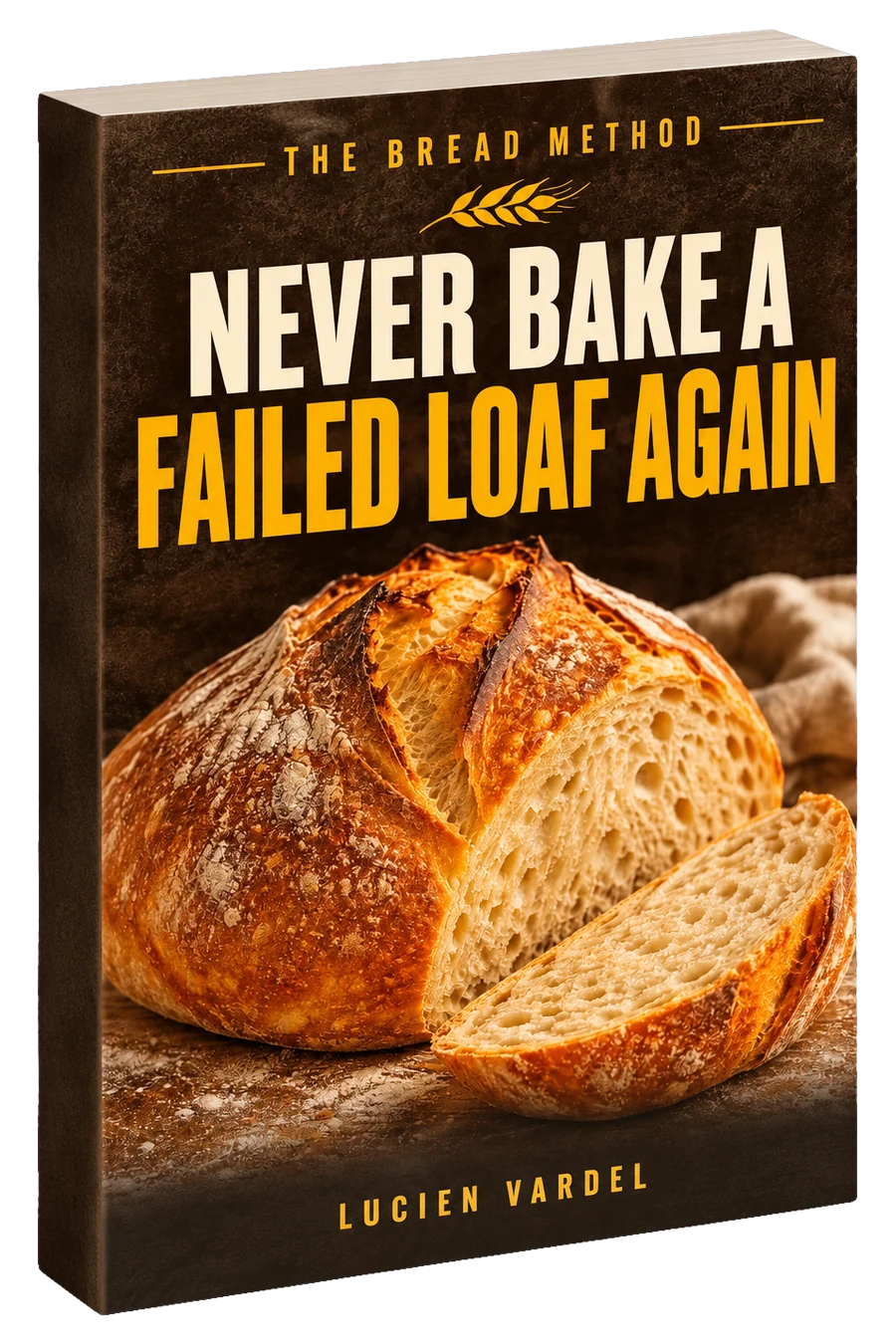
Never Bake a Failed Loaf Again: the 3 checks before you change recipes, then the 7 failed loaves, one by one.
This book is not another collection of recipes. It is a path of 29 lessons, each built the same way: what you see, what to look at, the rule, then an exercise with its own success criterion, “It worked if”, that you check yourself.
It ends with 5 printable sheets, to fill in with a pencil next to the oven. This is a digital book to download, not a paper book shipped to your door.
Here is a preview of what you are going to learn, part by part
Part 0 · I followed the recipe exactly
Why a recipe can fail in your kitchen and not in the author's.
- Why changing recipes fixes nothing when the kitchen or the yeast is the cause.
- The order of the 3 checks, and why the kitchen comes first.
- How to cut a failed loaf and read its 4 zones: crust, top of the crumb, centre, base.
Parts 1 to 3 · The 3 checks
Your kitchen, your yeast or starter, your recipe and its flour.
- The temperature where your dough rises, and the sign rather than the clock.
- Your yeast: which one, how old, how much; your starter: its age and whether it doubles.
- Your flour is not the recipe's flour: the flour chart by country, and grams rather than cups.
Part 4 · The test loaf
1 loaf, always the same, to learn your kitchen and your oven.
- A simple yeast loaf, weighed once and written down.
- Baked and read: the crust, the crumb, the core temperature, cut only once cool.
- 1 setting changed at a time, and 2 batches compared.
Part 5 · The 7 failed loaves
Each one: what you see, the checks first, then the other causes and the fix.
- No rise, flat, dense: what each one usually says.
- Sticky dough, gummy crumb: the water you hold back, the loaf you cut too early.
- Burnt or pale crust, big hole under the crust: the oven, the steam, the shaping.
Part 6 · Rescue it, then never repeat it
What can be saved, and the logbook.
- What can be rescued and what cannot.
- The diagnosis logbook, 1 line per failed batch.
- The 3 checks before any new recipe, including machine or sourdough recipes.
Here is where the book takes you
- A written temperature for your kitchen and your dough, instead of a guess.
- A test loaf you know by heart, to judge your oven.
- The name of each failed loaf, and the check that explains it.
- A logbook that tells you what you changed, and what it did.
A failed loaf stops being a mystery. It becomes a cause you can check, and a change you can write down.
Here is everything you get today
Everything is in PDF, to read on your phone or tablet in the kitchen, or to print so the sheets stay next to the oven. Here is exactly what you receive:
- The complete illustrated book “Never Bake a Failed Loaf Again” in PDF, 29 lessons (value $47)
- The 3 checks: your kitchen, your yeast or starter, your recipe and its flour (included)
- The test loaf, to learn your kitchen and your oven (included)
- The 7 failed loaves, each with its checks and its fix (included)
- 5 printable sheets, including the diagnosis logbook (included)
Value: $47 → today:
This price will not last: it will go back up to $47. By ordering today, you lock it in at $17. A single payment, no subscription.
Our 30-day satisfaction guarantee
I know what it is like to throw away a loaf without knowing what went wrong. That is why I take the risk off your side and put it entirely on mine.
Get the book today, read it, and above all do the exercises, 1 lesson at a time. If, after 30 days, it has not helped you, send a simple email to contact@thebreadmethod.com. We refund your purchase in full, no questions asked, no justification needed.
In other words: either this book moves you forward, or it costs you nothing.
P.S. Here is the summary: by ordering today, you get the illustrated book “Never Bake a Failed Loaf Again” for $17 instead of $47, to check your kitchen, your yeast and your recipe before you change recipes, and to find the cause of a failed loaf by cutting it. And if, within 30 days, the book does not help you, you get a full refund, no questions asked.
P.P.S. Remember: the $17 price will not last. The next time a loaf comes out flat, you can look for another recipe, or you can run the 3 checks. A few minutes, and you know what happened.